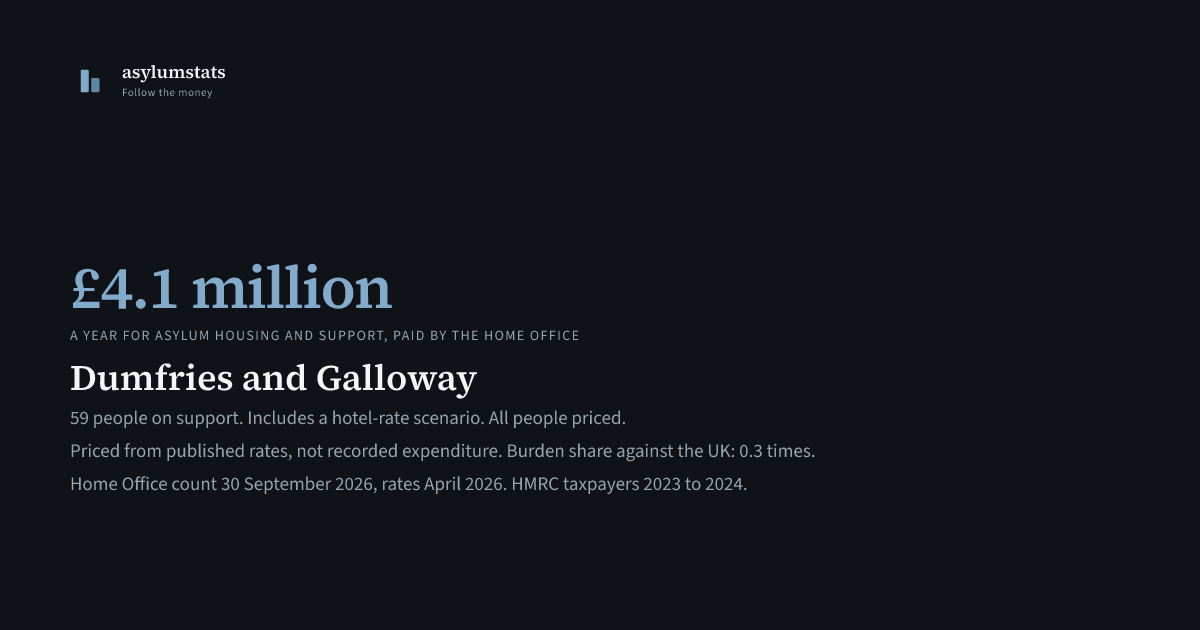
Dumfries and Galloway
59 on asylum support at 30 September 2026, up 29 from 30 at 30 June 2026.
People in receipt of Home Office asylum support living in the area. Home Office, Immigration system statistics, regional and local authority data, table Reg_02: year ending September 2026 (published 26 November 2026) and year ending June 2026 (published 27 August 2026).
59 people on asylum support in Dumfries and Galloway
Rank 225 of 361 councils nationally. The rate of 4.1 per 10,000 puts Dumfries and Galloway in the 38th percentile. That means a moderate load compared to the national picture. 2 of them receive subsistence only and are not in Home Office accommodation. 57 in contingency accommodation, a category that includes hotels. Priced from the local accommodation mix, housing and support come to about £4.1 million a year, paid by the Home Office. Contingency places are priced at the hotel rate as a scenario. The working is shown below.
Home Office accommodation and support
What housing and supporting people seeking asylum in Dumfries and Galloway costs
£4.1 milliona year, paid by the Home Office
Estimate from published rates, not a spending record
57 people in Dumfries and Galloway are in contingency accommodation, the Home Office category that includes hotels. It does not publish how many are in hotels, so all are priced at the £199 hotel rate as a scenario, 100% of the figure. Where some are in other temporary housing at a different rate, the true cost will differ.
- Contingency, incl. hotels 57
- Subsistence only 2
How the figure is worked out
People on support at 30 September 2026, multiplied by the Home Office's April 2026 rate for their type of accommodation, held constant for a year.
- Contingency, priced at the hotel rate57 people × £199 a night × 365 nights£4,140,195
- Subsistence only, no accommodation2 people × £49.18 a week × 52 weeks£5,115
- Priced subtotal£4,145,310
Excludes the grant paid to councils and any cash allowance for people in accommodation, pending a check of what the nightly rates cover. At the earlier rates for the end of June 2025, the same people come to £3.0 million.
People on support compared with income taxpayers
- Dumfries and Galloway, per 1,000 taxpayers
- 0.7
- UK, per 1,000 taxpayers
- 2.6
- Burden share against the UK
- 0.3 times
The UK figure divides everyone on support by the sum of HMRC's local income taxpayer counts, two of which are unpublished. It is a relative comparison, not a target for how many people an area should support.
59 people on support. Home Office, Reg_02, 30 September 2026. HMRC Personal Incomes Statistics, Tables 3.14 and 3.14a, tax year 2023 to 2024. Taxpayer counts are sample estimates.
If it were shared out locally
Local equivalents show what the priced subtotal would be if divided locally. They are not bills charged to local taxpayers or households.
- Per local income taxpayer
- £50
- Per chargeable dwelling
- Unavailable
- Per resident
- Unavailable
Rounded to the nearest £10, or £1 below £10.
Chargeable dwellings are available for England only; no denominator is substituted.
The synced ONS population file covers England and Wales only.
Not comparable with the national figure of £197 per UK income taxpayer for 2025-26, which divides the estimated cost of the whole asylum system, not just local housing and support, using HMRC's matching-year projection.
Count: 30 September 2026 · Nightly rates: April 2026 · Taxpayers: 2023 to 2024 · Dwellings: 6 October 2025 · Population: 30 June 2025
Full sources, exclusions and uncertainty
Annualised priced subtotal, paid by the Home Office. This uses 365 nights and 52 weekly payments at a constant count; it is not expenditure recorded for this area.
Home Office Reg_02, Year ending September 2026, published 26 November 2026. Area code S12000006; accommodation definitions: Notes 24, 26 and 27. Nightly rates April 2026, published 17 September 2026. Allowance since 15 January 2024 (SI 2023/1372).
Contingency accommodation is priced at the published hotel rate as a scenario. The source category includes hotels and may include other temporary accommodation.
Accommodated cash allowances are excluded pending verification of what the nightly rates include. Meal coverage is unknown. The standard and catered allowances differ. Standard support is £49.18 a week; catered support is £9.95 a week (since 2 June 2025, up from £8.86).
Adding the ordinary standard allowance for every accommodated person would add £145,770 annually. This is a sensitivity calculation, not a claim about payments or an upper bound on all costs. Extra family payments are unpriced.
Grant instruction, 2026 to 2027, published 31 March 2026: Actual grant payments are unavailable. The annual grant uses the March baseline, excludes Large Sites CA and covers England, Scotland and Wales. Monthly growth payments and local eligibility cannot be calculated from this snapshot.
For comparison only, applying £1,200 to the current dispersal and contingency counts gives £68,400. This excludes initial and other accommodation and is not a grant entitlement or payment. The actual baseline is 30 March 2026; monthly growth payments of £100 per additional eligible occupied bed are unpriced.
The same priced components at end of June 2025 nightly rates (£23.25 dispersal, £144.98 hotel) give £3,021,424. This is a lower-rate scenario, not a confidence bound.
HMRC Tables 3.14 and 3.14a, tax year 2023 to 2024, published 29 April 2026. Table_3_14, row 367, cell L367; Table_3_14a_No_of_individuals, row 367. Taxpayers: 82,000. 95% interval: 77,000 to 88,000.
Cost equivalent using those bounds: £50 to £50 per taxpayer, rounded to the nearest £10, or £1 below £10. The interval reverses the HMRC 95% taxpayer bounds, holding the cost subtotal fixed. It is not a confidence interval for costs and excludes uncertainty in rates, allowances and grants.
The UK figure divides everyone on support by the sum of HMRC's local income taxpayer counts, two of which are unpublished. It is a relative comparison, not a target for how many people an area should support.
Chargeable dwellings, Table 1.07: unavailable. Revised 21 January 2026.
ONS population: unavailable. The data tables in this spreadsheet were originally published at 9.30am 29 July 2026.
Two housing systems, side by side
Homelessness and asylum housing in Dumfries and Galloway
Homelessness statistics for Scotland are published separately by its own government and are not included here yet. This section covers English councils only.
How many asylum seekers are in Dumfries and Galloway?
59 people were receiving Home Office asylum support in Dumfries and Galloway at 30 September 2026, the most recent quarter published. That ranks 225th of 361 UK local authorities. It counts people on support at that date, which is not the number who claimed asylum there and not the number waiting for a decision.
How many asylum seekers per 10,000 people are in Dumfries and Galloway?
4.1 per 10,000 residents, which places Dumfries and Galloway in the 38th percentile of UK local authorities. It carries fewer per head than 62% of the country. Rate is the fair comparison between areas, because a large city carries more people than a small district at the same pressure per head.
Are there asylum hotels in Dumfries and Galloway?
The Home Office does not say. 57 people in Dumfries and Galloway were in contingency accommodation at 30 September 2026, and contingency accommodation is the category that includes hotels. No site in the area has been named in council papers, a parliamentary answer or published reporting, so the buildings are not identifiable.
Who houses asylum seekers in Dumfries and Galloway?
Mears holds the Home Office asylum accommodation contract for the region Dumfries and Galloway sits in, under the Asylum Accommodation and Support Contracts. The contract covers a whole region rather than a single council, and the Home Office does not publish a council-by-council split of which properties sit under it.
Are all of them in Home Office accommodation in Dumfries and Galloway?
No. 2 of the 59 on support in Dumfries and Galloway, about 3%, receive subsistence only: a cash payment with no accommodation, usually because they are living with friends or family. The rest are in Home Office accommodation, which covers dispersal housing and hotels.
Dumfries and Galloway: asylum numbers falling
Quarter-end stock series to Jun 2026. A rise or fall is a net change in the number of people on support at period end, not the number of new claims or distinct people moving through the caseload. Support stock also overlaps with, but is not identical to, the awaiting-decision backlog.
Exact values
| Period | Value |
|---|---|
| Mar 2022 | 1 |
| Jun 2022 | 2 |
| Sept 2022 | 2 |
| Dec 2022 | 2 |
| Mar 2023 | 2 |
| Jun 2023 | 1 |
| Sept 2023 | 53 |
| Dec 2023 | 42 |
| Mar 2024 | 58 |
| Jun 2024 | 72 |
| Sept 2024 | 81 |
| Dec 2024 | 86 |
| Mar 2025 | 70 |
| Jun 2025 | 104 |
| Sept 2025 | 107 |
| Dec 2025 | 91 |
| Mar 2026 | 47 |
| Jun 2026 | 30 |
Trend
-17Latest quarter change
+29Change across series
18Official data points
Local numbers
Accommodation split
Dispersal accommodation0
Initial accommodation0
Subsistence only2
Contingency accommodation57
Pathway breakdown
Other routes
Homes for Ukraine309
Afghan programme27
Resettlement cumulative79
Population context
All pathways total395
Share of local population0.27%
Local geographyThe shared local-authority geography record and its source coverage.Place record on UK Places
National benchmarks
Supported asylum count
59National distribution.
Supported asylum rate
4.1Per 10,000 residents.
Contingency accommodation
57Hotel and contingency placements.
Regional peers
Top 6 in Scotland by supported asylum.
The national picture
How Dumfries and Galloway fits into the UK figures people look up most.
How many asylum seekers are in the UK?93,453on asylum support, 30 September 2026Read the answer →How many small boats have crossed the Channel in 2026?23,983small boat arrivals, 1 January to 19 November 2026Read the answer →How many asylum hotels are there in the UK?Under 160asylum hotels in use, 12 August 2026Read the answer →How much does an asylum hotel cost per night?£199per person per night in a hotel, April 2026Read the answer →What does asylum cost the UK?£7.8bn a year£197 per income taxpayer, in a range of £178 to £215. Central estimate.Read the breakdown →
Who represents Dumfries and Galloway
The MP to write to about asylum accommodation in this area.
John Cooper