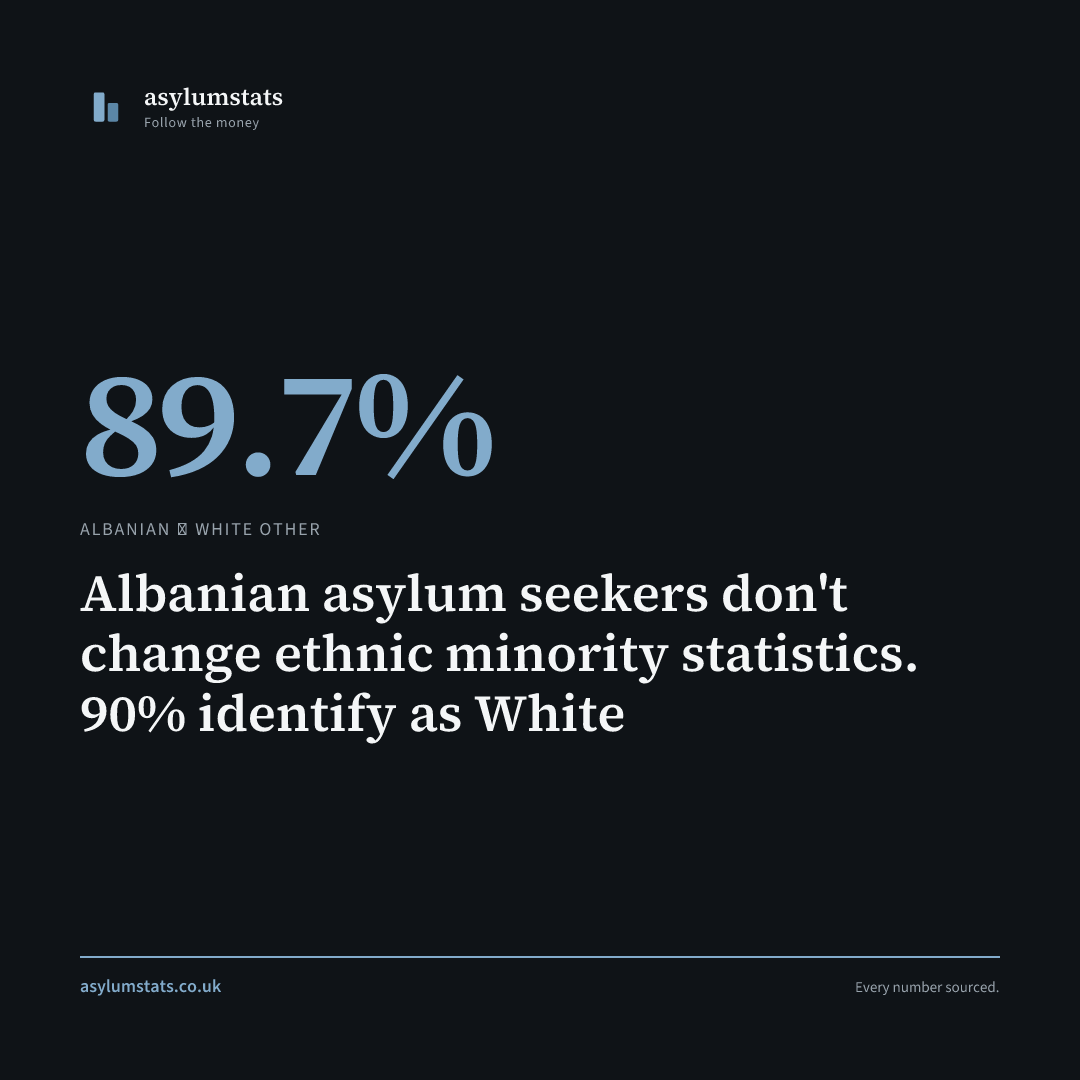
Albanian asylum seekers don't change ethnic minority statistics. 90% identify as White
The second-largest asylum nationality produces no change in ethnic minority statistics.
Albania is the second-largest source of asylum claims in UK history. 57,360 decisions to date, with an 17.4% grant rate. Public debate often treats Albanian migration as part of ethnic diversification. Census data tells a different story.
89.7% of people with Albanian heritage identify as White Other in Census 2021. Only 10.3% identify under any other category. This means Albanian asylum seekers, whether granted protection or not, contribute to the “White Other” category in demographic data, not to Asian, Black, or other ethnic minority statistics.
The practical implication: when a council’s White British percentage falls, Albanian migration is part of the cause, but it does not increase the ethnic minority population that drives demand for interpretation services, culturally-specific provision, or EAL school support in the same way that, for example, Afghan migration (82% Asian) or Somali migration (93% Black) does.
Other notable mappings from our TS022 analysis:
- Afghan (115,226 in Census 2021): 82.2% Asian, 17.8% Other
- Somali (218,029): 93.3% Black, 6.7% Other
- Iranian (103,810): 51.2% Other, 36.7% Asian, 7% White Other (the most ethnically complex mapping)
- Polish (602,171): 98.4% White Other
- Pakistani (1,577,112): 99.6% Asian
Methodology: Census 2021 TS022 provides 294 detailed ethnic sub-categories at local authority level. We mapped 27 asylum-relevant nationalities to Census ethnic groups. Iraqi and Syrian populations lack dedicated TS022 sub-categories and use manual estimates (55% Other, 40% Asian). The mapping uses self-identified ethnicity and includes UK-born descendants, not just recent migrants.
Share this finding. Right-click to save the image.