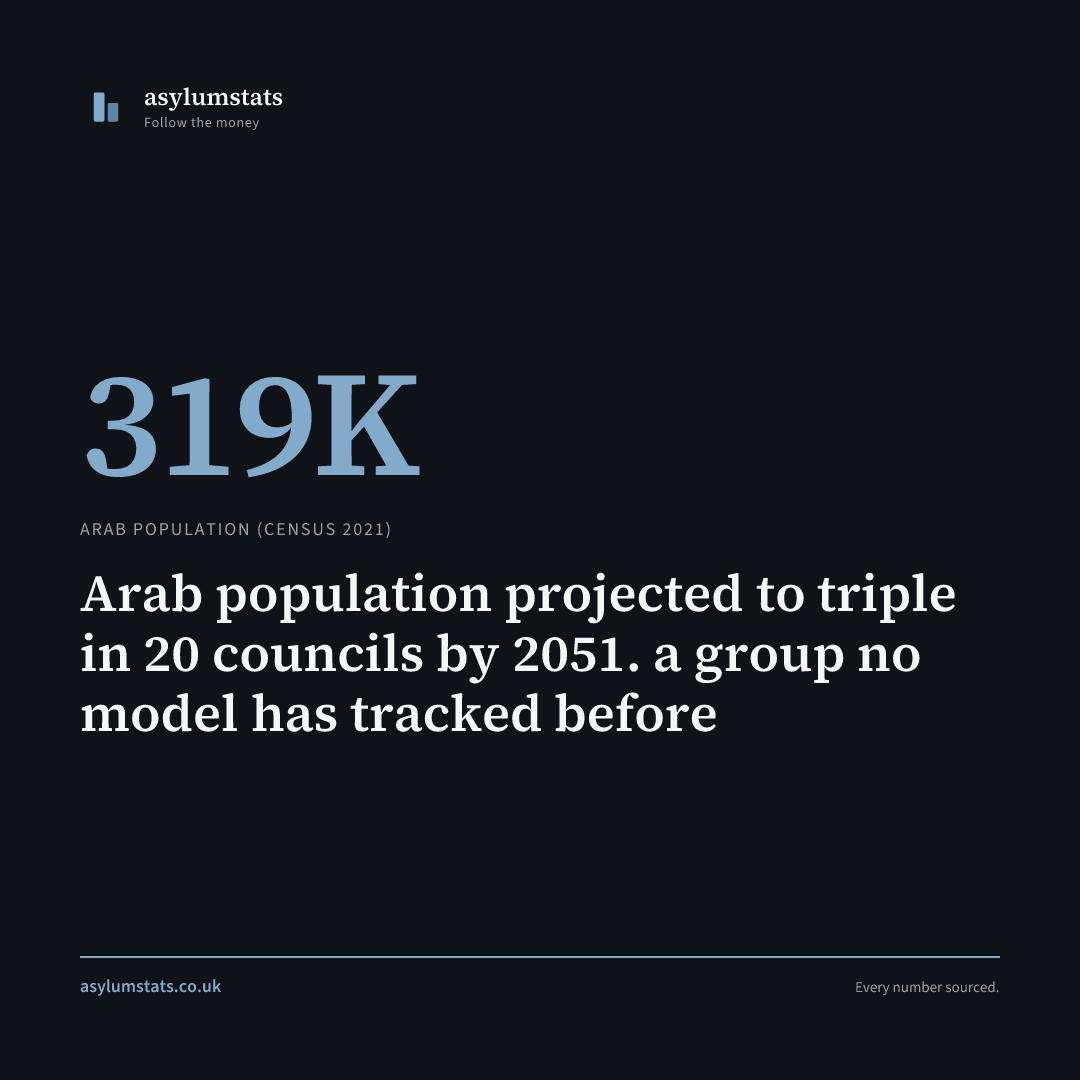
Arab population projected to triple in 20 councils by 2051. a group no model has tracked before
No demographic model has ever projected the Arab population of England separately. Until now.
Census 2021 introduced a standalone “Arab” ethnic category. Previous projections, including NEWETHPOP and our own earlier model, lumped Arab with “Other ethnic group”, making it invisible in demographic analysis. Our v8.0 model, built on the ONS Census 2021 custom dataset with 20 ethnic groups, projects Arab population dynamics for the first time at local authority level. The figures here were revised down on 13 August 2026 when the model was recalibrated against an out-of-sample test; the previous settings projected minority growth too fast.
There are 319,452 people who identified as Arab in Census 2021. 0.58% of England’s population. By 2051, our projections show this rising to 1.8% nationally, with far higher concentrations in specific areas.
The fastest-growing Arab communities:
- Brent: 5.3% to 12.9% by 2051
- Ealing: 4.4% → 13.9%
- Westminster: 7.6% to 9.2% by 2051
- Harrow: 2.4% → 10.8%
- Kingston upon Thames: 2.1% → 10.5%
- Manchester: 2.7% → 8.8%
- Liverpool: 1.7% → 8.7%
- Birmingham: 1.7% → 8.1%
The asylum link: The nationality-to-ethnicity mapping shows that asylum seekers from Iraq, Syria, Yemen, and Libya (all with 80%+ grant rates) will primarily identify as Arab in Census terms. Arab population growth is therefore partly driven by successful asylum claims and subsequent family reunion. This is the first model to make that link quantifiable.
Methodology: Hamilton-Perry v8.0 with 20 ethnic groups. Census 2021 direct observations (no IPF). Arab group separated from “Other” for the first time. CWR-implied TFR for Arab population: approximately 2.02 (above White British 1.71). SNPP 2022-based envelope constraint. These are demographic projections assuming 2011-2021 patterns persist, not forecasts.
Share this finding. Right-click to save the image.