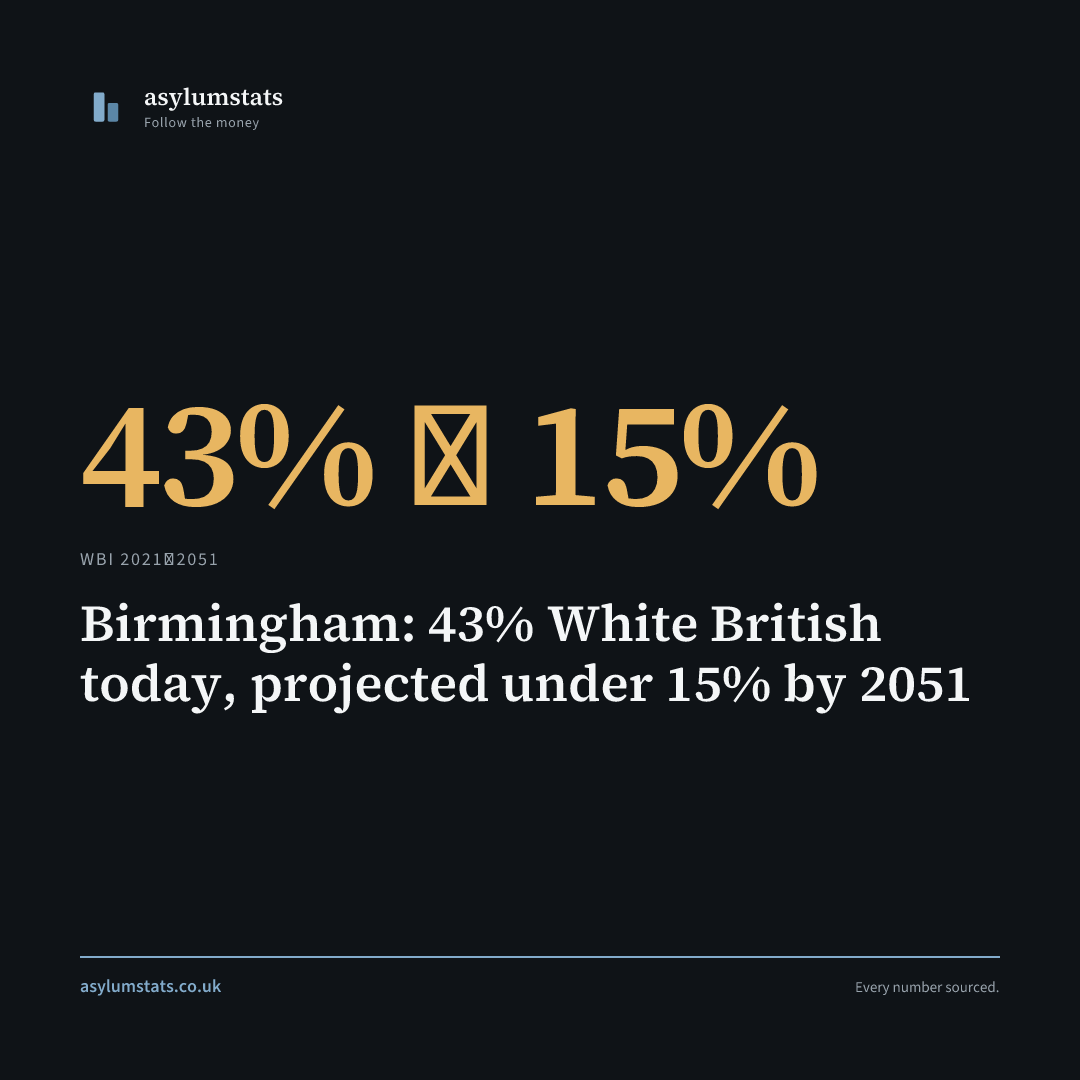
Birmingham: 43% White British today, projected under 15% by 2051
Correction, 12 October 2026. This page had not carried the corrections made to the same finding on UK Demographics on 7 September 2026, and several figures did not match this site’s own projection data. The badge read 43% → 11%; the 2051 projection is 14.9%. Three rows of the projection table were output from before the 13 August 2026 recalibration: 2031 is 32.8%, not 31.7%; 2041 22.9%, not 20.1%; 2061 9.1%, not 4.7%. Birmingham’s 2021 Christian share is 36.2%, not 29.9%: the 29.9 is the raw Census Muslim share, and the two were crossed. The claim that the Muslim share already exceeds the Christian one is withdrawn, because it is false on either scaling, 31.8% against 36.2% renormalised or 29.9% against 34.0% raw (Census 2021 TS030). The projection puts the Muslim share at 47.5% in 2041 and 53.5% in 2051, so a Muslim majority falls in the middle of the 2040s, not the early 2040s. Arrivals from outside the UK in the year before the Census were 1.2% of the population, not 2.3%. Birmingham’s decade fall, 10.2 points, was not the fastest of any English city over 500,000 people: Manchester fell 10.6. The piece named Solihull, Worcestershire and Warwickshire as destinations of White British movers and said Census migration data confirms it; this site holds no Census origin and destination data, so that is withdrawn. Census figures from Census 2021 TS021 and TS030 and Census 2011 KS201EW; projections from this site’s Hamilton-Perry v8.0 data.
Correction, 7 September 2026. This piece credited the projection to a fertility gap, Pakistani TFR 2.52 against White British 1.31, and said the true outcome “sits between” the two models. Neither holds. The model does not use total fertility rates: it runs on Census-derived child-woman ratios, which fold fertility, age structure and migration into one observed ratio per cohort, so the TFRs are context from ONS births data and not an input. And two models agreeing does not bracket the truth, because both can share a bias. Here they did: the v8.0 recalibration on an out-of-sample test moved Birmingham’s 2051 share from 10.7% to 14.9%, outside the range the earlier text implied. The Census figures, the direction of travel and the 2051 projection stand.
53% White British in 2011. 43% in 2021. The trajectory does not stop.
Census 2021. Birmingham. 42.9% White British. Down from 53.1% ten years earlier. Ten percentage points. One decade. Of the English local authorities with more than 500,000 residents, only Manchester fell faster, by 10.6 points.
The numbers going forward:
| Year | White British |
|---|---|
| 2011 | 53.1% |
| 2021 | 42.9% |
| 2031 | 32.8% |
| 2041 | 22.9% |
| 2051 | 14.9% |
| 2061 | 9.1% |
Four things drive this.
Fertility. White British TFR nationally: 1.31 children per woman (ONS 2024 births data). Pakistani TFR: 2.52. Birmingham’s Pakistani population is 17.0%. The model does not use these rates. It uses child-woman ratios from the two censuses, which capture the fertility gap as observed in Birmingham along with the age structure and migration behind it. Every cohort so far has been less White British than the last.
Age structure. Birmingham’s White British population skews older. The younger cohorts are already majority non-White-British. White British pupils are 24.7% of the city’s school roll in 2024/25, against 42.9% of the population. The demographic wave is already in the system.
White flight. Birmingham gained 71,877 residents between the two Censuses and lost 79,006 White British ones, from 570,217 to 491,211. Every other broad group grew. Census 2021 origin and destination data is not in this site’s dataset, so this piece names no destination.
International settlement. Birmingham is a major settlement city. 1.2% of the population had moved to it from outside the UK in the year before Census 2021. South Asian and African countries dominate.
The models agree on direction. The Hamilton-Perry model projects 14.9% White British by 2051, revised up from 10.7% when the model was recalibrated on 13 August 2026: the settings it used before were projecting change too fast. The cohort-component model, which assumes ethnic fertility rates converge partway to the national mean, projects a higher share still. Agreement between two models narrows nothing: both can carry the same bias, and until the August recalibration both did. Both agree Birmingham passed majority non-White-British years ago; the question is how fast it continues.
Religion. Birmingham’s Muslim population: 31.8% in 2021. Christian: 36.2%. Both are Census 2021 TS030 shares of the residents who answered the religion question. The projection puts Muslim at 47.5% in 2041 and 53.5% in 2051, so the crossing falls in the middle of the 2040s. First major English city.
Birmingham is not the exception. It is the preview. Leicester, Luton, Slough: similar trajectories. Blackburn: projected minority White British by the late 2020s. The dynamics are national. Birmingham just gets there first.
Source: Census 2021 custom dataset (direct observations, 20 ethnic groups). Hamilton-Perry v8.0 single-year CCR model, SNPP-constrained, recalibrated on an out-of-sample test (MAE 1.56pp, bias +0.05pp). Census 2011 DC2101EW (observed, not proportionally split). The backcast score previously quoted here has been withdrawn; it measured the model’s own guardrails rather than its accuracy. See the methodology.
Share this finding. Right-click to save the image.