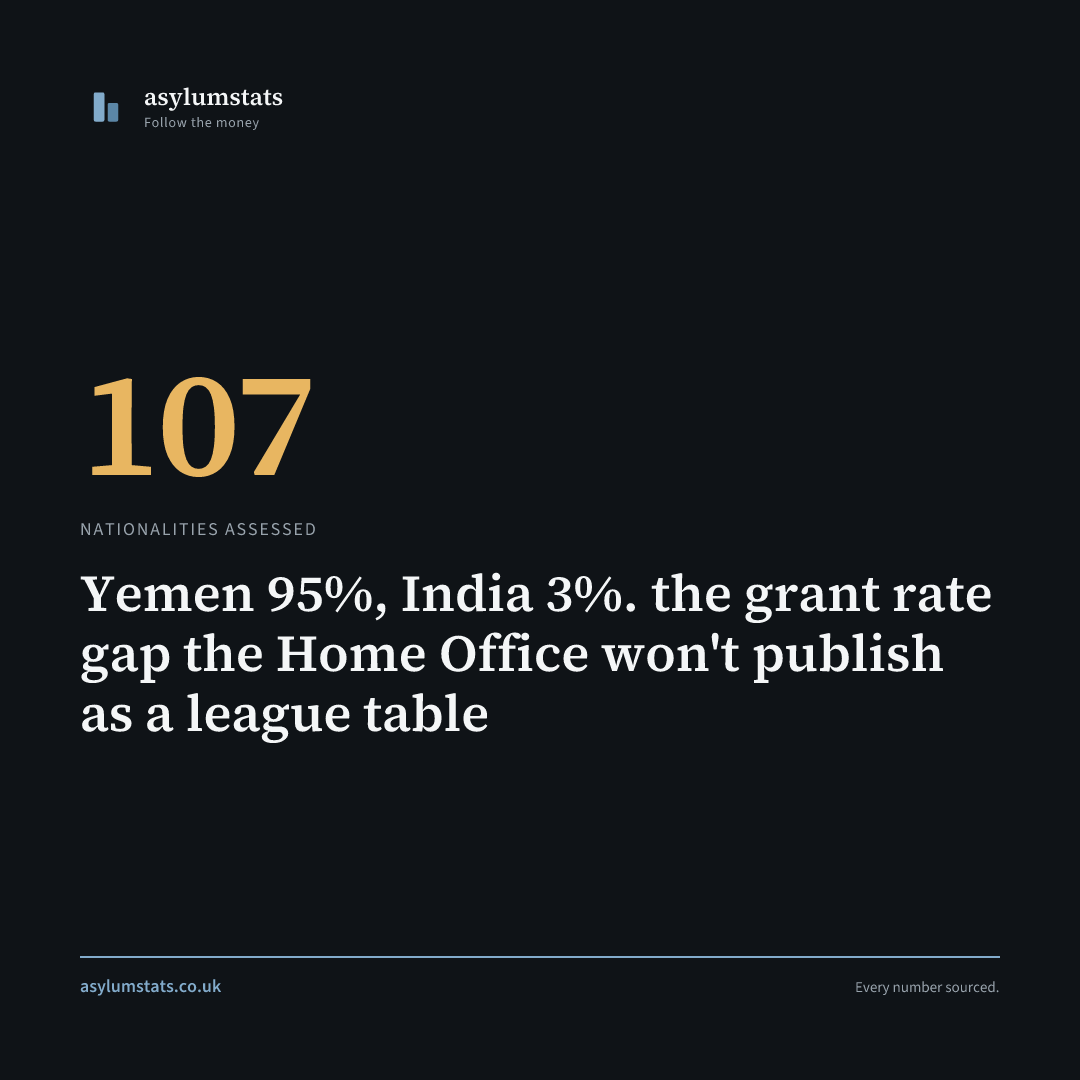
Yemen 95%, India 3%. the grant rate gap the Home Office won't publish as a league table
The Home Office publishes 139,000 rows of asylum decision data. It does not publish a league table by nationality.
We built one. Using every initial asylum decision recorded in Asy_D02 from 2020 to 2025, we computed the grant rate for each nationality: the proportion of substantive decisions (grants + refusals, excluding withdrawals and administrative outcomes) that resulted in protection being granted.
The result splits asylum claimants into two clear groups.
Genuine refugees (75%+ grant rate, 11 nationalities): Yemen (95%), Syria (93.6%), Sudan (92.9%), Eritrea (91.1%), South Sudan (88.7%), Myanmar (85.7%), Libya (83.8%), Palestine (81.3%), Saudi Arabia (80.6%), El Salvador (79.6%), Uganda (76.3%). These are people fleeing war, persecution, and state violence. The system confirms it. their claims are overwhelmingly granted.
Likely economic migration (under 25%, 41 nationalities): Hungary (0%), Lithuania (0%), Poland (0.8%), Brazil (2%), India (2.9%), Nepal (2.9%), Romania (3%), Georgia (5.7%). These claims are overwhelmingly refused. The claimants come from safe countries with no war or systematic persecution.
The biggest single finding: India. 2.9% grant rate on 9,365 substantive decisions since 2020. That is 9,093 claims that consumed caseworker time, legal aid, and accommodation before being refused. At an estimated processing cost of several thousand pounds per claim, YOUR money, wasted on claims the system itself considers unfounded.
Important caveat: these are initial decision rates only. Many refusals are overturned on appeal. Iran’s initial grant rate is 72.4% but rises to approximately 85% after successful appeals. The true grant rate, after all appeals are exhausted, is higher for many nationalities.
Methodology: Grant rate = (grants of protection + grants of other leave) / (grants + refusals) × 100. Excludes withdrawn cases and administrative outcomes. “Refugee” and “Stateless” status entries excluded (not nationalities). Post-2009 data is fully disaggregated by age, sex, applicant type, and UASC status; all rows summed, no double-counting. Minimum 50 substantive decisions for league table inclusion.
Share this finding. Right-click to save the image.