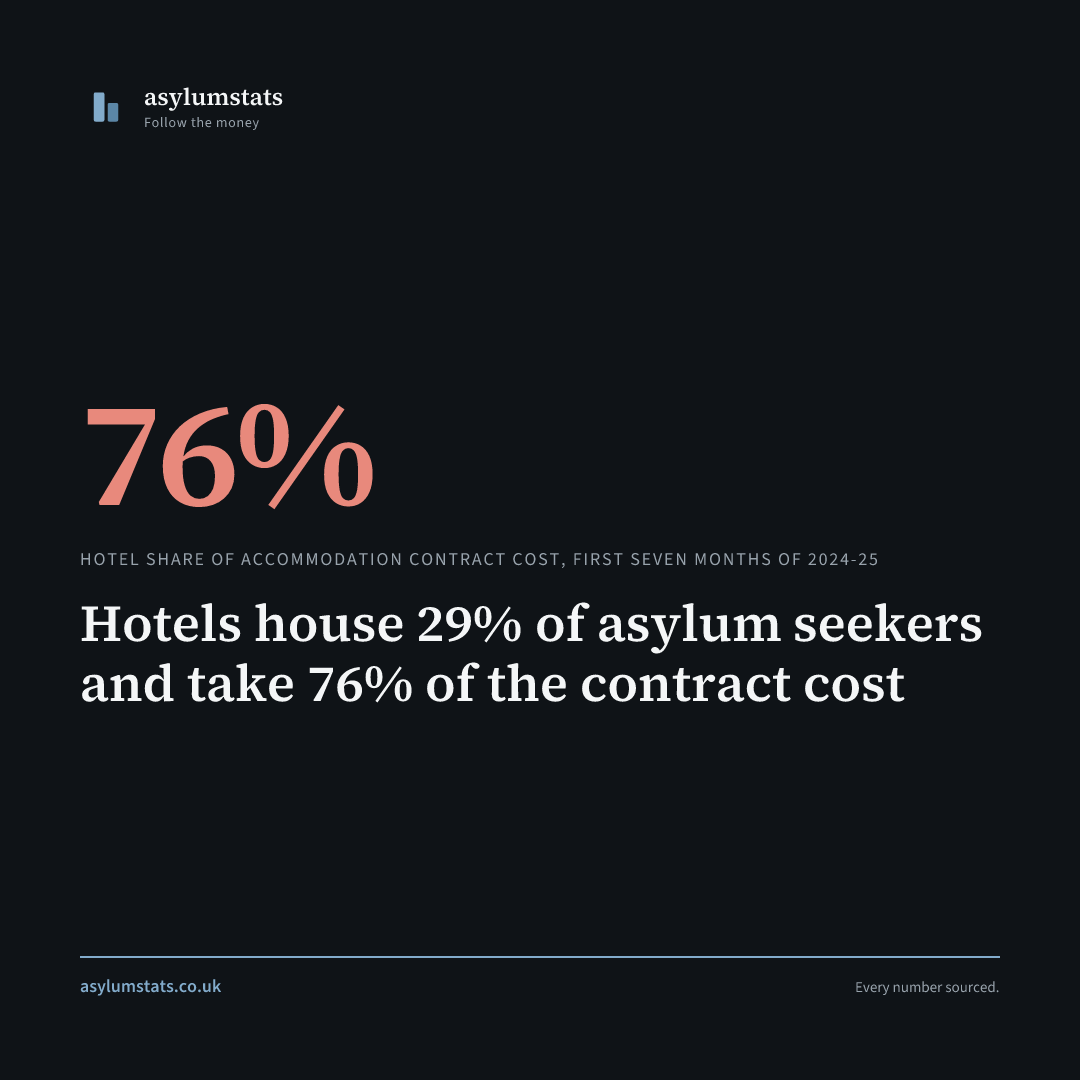
Hotels house 29% of asylum seekers and take 76% of the contract cost
The arithmetic of asylum hotels is simple. And damning.
| Accommodation type | People | Share of contract cost | Cost per person |
|---|---|---|---|
| Hotels (contingency) | ~31,000 (29%) | 76% | ~£188/night |
| Dispersal housing | ~76,000 (71%) | 24% | ~£18/night |
The 76 per cent is the share of the accommodation contracts, not of all asylum spending, and it covers the first seven months of 2024-25. The NAO corrected this on 1 July 2025, striking the word “annual” from its original wording.
Hotels cost roughly ten times more per person per night than dispersal accommodation. Yet nearly a third of the supported population remains in hotels.
197 hotels. The Home Office publishes the number of asylum hotels in use but not a complete list of sites. Parliamentary questions, FOI requests, and local council disclosures have identified some locations, but the full estate remains partially opaque.
31,000 people. This is the contingency accommodation population as at the latest published snapshot. It includes hotels, former military sites, and large-scale accommodation centres.
£5.77 million per day on hotels across 2024/25, £2.1 billion for the year (House of Commons Library, CDP-2025-0184). The 10-year asylum accommodation contract is forecast at £15.3 billion (NAO).
Why hotels persist: The asylum backlog creates the demand. With 64,426 people waiting for an initial decision, and the average wait exceeding 12 months, the accommodation system cannot place everyone in dispersal housing fast enough. Hotels fill the gap. at ten times the price.
The three prime providers. Serco, Mears Group, and Clearsprings Ready Homes. operate regional monopolies over asylum accommodation, including hotel procurement. Their contracts are the mechanism through which the hotel budget flows.
Data sources: NAO asylum accommodation investigation. Home Office quarterly immigration statistics (Dec 2025). Hotel cost share from parliamentary scrutiny reports.
Share this finding. Right-click to save the image.