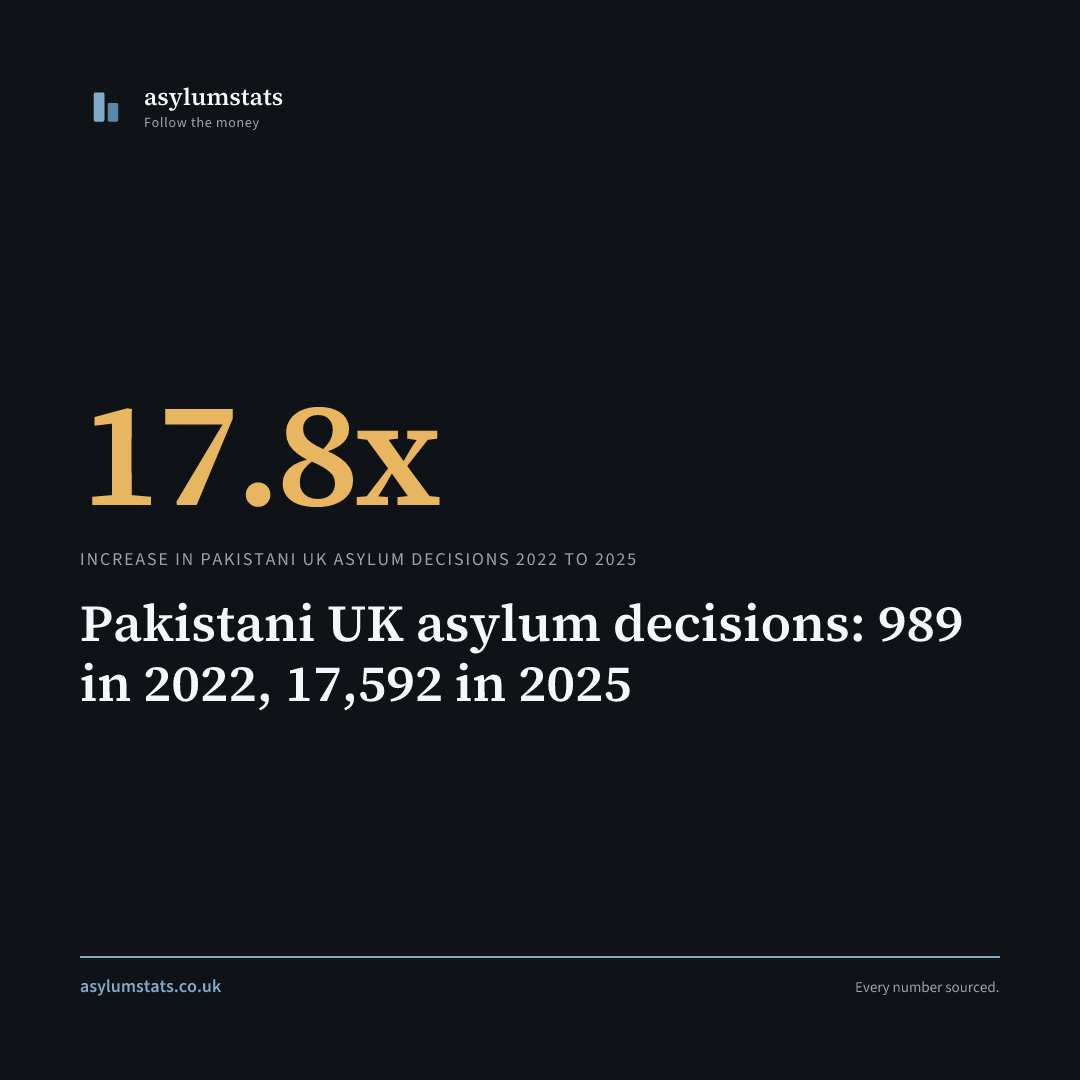
Pakistani UK asylum decisions: 989 in 2022, 17,592 in 2025
Pakistan is now the UK’s largest single source of asylum claims. The Home Office processed 17,592 Pakistani asylum decisions in calendar 2025, up from 989 in calendar 2022. That is a 17.8 times increase in three years.
The Asy_D02 dataset, released 21 May 2026, tracks Pakistani decisions by year:
- 2022: 989 decisions, 60.3 percent initial grant rate
- 2023: 4,273 decisions, 56.3 percent initial grant rate
- 2024: 6,473 decisions, 51.3 percent initial grant rate
- 2025: 17,592 decisions, 32.4 percent initial grant rate
Two things changed simultaneously. Volume rose 17.8 times. The initial grant rate fell from 60 percent to 32 percent. The Home Office processed more Pakistani claims and refused proportionally more of them.
After appeals, the picture stabilises. The Asy_D04 outcome analysis shows the true grant rate for Pakistani claims, after appeals, at 49.8 percent. The Home Office initially refuses approximately 68 percent of Pakistani claims. Roughly 14 percentage points of that refusal rate is overturned on appeal.
Why the surge
The Pakistani political collapse since 2023 is documented in primary sources. Former Prime Minister Imran Khan was arrested in May 2023 and sentenced to 14 years in prison in January 2025. PTI, his party, was prohibited from using its election symbol in the February 2024 general election and continues to be subject to legal restrictions on assembly and candidacy. In August 2025, 108 PTI members were sentenced for their role in the May 2023 protests.
Human rights reporting from Amnesty International, the United States Commission on International Religious Freedom (USCIRF), and Pakistani independent media including The Friday Times has documented:
- Blasphemy laws that carry the death penalty for proven cases and routinely produce mob violence including in cases recorded in 2024 and 2025
- Systematic persecution of Ahmadi Muslims, Shia Muslims, Christians and Hindus
- Targeting of LGBTQ communities including reported forced disappearances
- Provincial unrest in Khyber Pakhtunkhwa and Balochistan, with the Tehrik-i-Taliban Pakistan insurgency causing more than 1,000 deaths a year since 2023
- Economic collapse, with currency devaluation, IMF programme conditions, and food insecurity
The Home Office’s own Country Policy and Information Note on Pakistani political parties and affiliation, published February 2026, documents the PTI persecution and provides UK asylum decision-makers with the case-handling framework. That framework now exists because the volume of claims forced it to exist.
Pakistan’s wider 2025 UK migration footprint
Pakistan in 2025 was not only the top asylum source. It was also:
- 7th in work visa grants: 3,739
- 3rd in student visa grants: 30,720
- 2nd in citizenship grants 2024 to 2025 combined: 41,299
- 1st in NINo registrations excluding India: 56,201
- 8th in returns: 1,406
Pakistan supplies the second-largest cohort of new British citizens, the third-largest cohort of international students, and the largest cohort of asylum claimants, in the same year, from the same country. The Pakistani-British community is one of the oldest established South Asian communities in the UK, with a recorded Pakistani ethnic population of around 1.6 million in the 2021 Census.
Two narratives, both supported by the data
The “asylum as parallel immigration route” framing has Pakistan as exhibit A. 17,592 decisions in one year is comparable in volume to the entire Skilled Worker grant load for medicine and IT professional categories combined. The Home Office is refusing 68 percent at initial decision. This framing reads the data as confirmation that most are economic migrants pursuing the asylum route in the absence of other legal pathways.
The “genuine refugee” framing has the post-appeal 49.8 percent true grant rate. Roughly half of Pakistani asylum claimants are found, after the full process, to have a legitimate protection need. The Pakistani diaspora political activism, the country’s documented religious persecution, and the targeting of PTI members and journalists support the framing.
Both framings can be defended. Both have the same Home Office data underneath. The choice between them is political, not empirical.
The Home Office Country Policy and Information Note
The CPIN on Pakistan political parties and affiliation was published in February 2026 to guide UK asylum decision-makers. The note documents:
- The PTI’s status under the current Pakistani government
- The mechanisms by which PTI members and supporters have been subject to legal and extra-legal action
- The categories of claim that are likely to engage the Refugee Convention or Article 3 ECHR
- The country-specific evidence base used in initial decisions
The CPIN’s existence is itself evidence that the UK asylum system regards Pakistan as a country producing genuine asylum cases at scale. The 32 percent initial grant rate and 50 percent true grant rate reflect the case-by-case application of that framework. Both numbers are consistent with the CPIN.
Sources
- Home Office Immigration System Statistics, year ending March 2026 release (21 May 2026), Asy_D02 and Asy_D04 datasets
- Home Office Country Policy and Information Note, Pakistan political parties and affiliation, February 2026
- Amnesty International Pakistan reporting 2024 to 2025
- US Commission on International Religious Freedom (USCIRF) Annual Report 2025
- Pakistan Institute of Conflict and Security Studies (PICSS) annual security reports 2023 to 2025
- 2021 UK Census, Pakistani ethnic group population
Share this finding. Right-click to save the image.